A Puzzling Conversation
PyWeek 42’s theme was “Borrowed Time”. I’ve wanted to make a point-and-click adventure for a while, so I gave it a go with a stupid plot about returning the borrowed components of a fabulous fancy-dress costume to their proper time zones before the timeline falls apart.
I love the LucasArts adventure games - Monkey Island, Indiana Jones: Fate of Atlantis, Sam and Max Hit the Road - and Ron Gilbert is one of my gamedev heroes. The theme brought to mind the time-hopping puzzles of Day of the Tentacle, and the idea of making something like that hooked me.
It All Depends
To design the interconnected game puzzles, I used a Puzzle Dependency Chart (PDC), as described by Gilbert on his blog. A PDC is a graph of every puzzle and puzzle step in the game, with an edge from each step to the steps that make it possible. It is not a flow chart. Rather than “what happens next”, a PDC shows “what does this depend on”.
Gilbert’s advice is to start from the end of a puzzle chain, and keep asking “what has to happen before this can?”. In his example, the goal “Open Basement Door” requires that you both unlock it and oil the hinges - two dependencies because, as Gilbert says, “There is nothing (NOTHING!) worse than linear adventure games”.
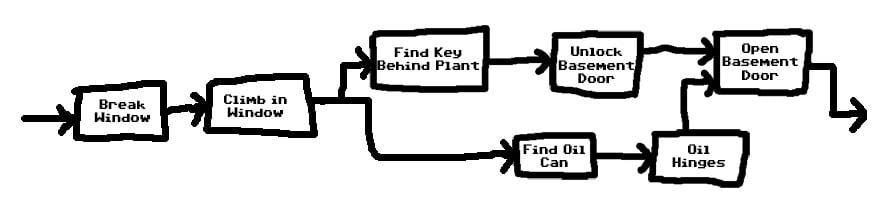
A PDC has a characteristic shape. Solving one puzzle opens up two or three new ones, and those collapse into a single solution that opens up the next batch. A sub-diamond of expansion and contraction, repeated.
A bad design shows up at a glance: too linear and it’s boring, too branchy and it’s confusing.
With my game goal set, I was ready to work backwards and build my PDC.
Talking to Mermaids
Gilbert uses the OmniGraffle app for drawing charts visually. I’d have to learn it from scratch, so I used my tame AI1 to build the chart, describing what I wanted and letting it turn that description into Mermaid markup.
My chart is a single Mermaid block in a markdown file, viewed in MDV, which live-reloads when the file changes. Here’s a fragment of it:
flowchart TD

  S(["INTRO — You start with the 4 borrowed garments (crown, hauberk, cloak, buckled shoes)"])
  W(["WIN — supervisor walks in at 9:30am to restored timeline"])

  %% 2026 — present day (Colegio de Reyes)
  BR2026(["2026 — get a loaf of pan de barra from the cafeteria"])
  OVG2026(["2026 — give the hourglass to the baker → she lends you the oven gloves"])

  %% 1666 — Great Fire era
  ASLEEP1666(["1666 — give Pepys brandy -> he falls asleep"])

  %% 122 — Londinium
  WARM122(["122 — give Hadrian the bed warmer in the teddy-bear oven gloves"])
  MAT122(["122 — get the leopard-skin from throne"])
  CROWN122(["122 — return crown -> get the pink beanie"])

  %% rest of the chart omitted
  S --> BR2026 --> OVG2026
  OVG2026 --> WARM122
  ASLEEP1666 --> WARM122
  WARM122 --> MAT122
  WARM122 --> CROWN122
  CROWN122 --> W
I had heard about developers talking to their AI and I thought it sounded like a laugh, so I used SuperWhisper, which transcribes what I say and types it directly into the current app — in this case a terminal running pi-dev connected to my local LLM. Any coding agent that can edit files will do. Pi edits the Mermaid block, MDV reloads, and the chart on screen reflects what I just said.
It was a productive and enjoyable way to work.
I would say something like this (real transcript excerpt!):
“The step where Raleigh presents the queen with the leopard skin rug, uh, to getting the denim jacket back from the queen, that’s kind of one step because he gives her the leopard skin, she puts it on and drops the denim jacket, allowing you to collect it.”
and Pi would modify the Mermaid code to merge the two nodes into one and rewire the edges. I just watched the graph change.
But beyond having the agent translate my mumblings into Mermaid markup, I prompted it to always check that the chart had no open ends and aligned with Gilbert’s advice on the shape of a “good” PDC. When I left a dependency vague — “the player needs to know Raleigh is in that cell” — the agent asked how the player learns this. And it warned if a section was too linear, or when too many puzzles were open at once.
Here’s the full PDC I built in this way:

One mildly annoying thing the AI kept doing was suggesting solutions to puzzle dependencies - its suggestions were usually horrible. AIs, even frontier ones, are weak at reasoning about the world and just aren’t funny. I think it’s best to keep the creative work in human hands. I could have asked it to only ask questions, but the bad suggestions gave me a starting point for better ideas.
I’d Like to Thank My Agent
I may be a curmudgeon, but I do not like to let AI code for me. Getting a model to write code is corrosive to my ability to read, write and reason about it. It’s worse than getting rusty. You learn to stop thinking and ask the AI.
But this wasn’t that. Learning Mermaid syntax by hand would not have improved my game design any more than installing OmniGraffle would. The value is in the graph of dependencies — which puzzles should require which steps — and that’s the thing I’m constructing and interacting with, not the Mermaid file.
I gained two benefits:
-
The feedback loop. Dictation is much faster than pointing and clicking boxes. I can spend my time thinking about what puzzles and story beats work instead of how to join two nodes with an edge. The chart changes as I speak, so the gap between having an idea and seeing it is almost instant.
-
The Socratic method. The agent asked questions and made bad suggestions, and I had to explain, correct and develop my thinking in response. It’s the talking rubber-duck again. Rather than doing my thinking for me, the AI prompted me to think more.
Time Flies

I ran out of time to submit, sadly. As ever, it was the art that took all the time — even after I gave up and asked ChatGPT to do it (I have no art skills to corrode).
But the PDC was the most fun part of the whole build. Raw creation, working backwards from the goal, figuring out the crazy dependencies the player has to untangle.
If you ever make an adventure game, you can’t go wrong stealing Ron Gilbert’s ideas. And if you steal mine, you may find yourself in a puzzling conversation with an AI too.
-
I’m currently running Swift-Qwen3.8-27B at IQ4_XS on a 7900XTX (24GB VRAM), which fits with a decent context window, and I get about 50 tok/s, which is very usable. ↩